
Wheat and Weeds - 7th Sunday After Trinity
I’m writing this from Newcastle having travelled up for the funeral of Stephen Pedley, the priest I worked with when I was first ordained. Stephen was then rector of St Mary’s Whickham, Gateshead, though he soon left to be one of the Residentiary Canons of Durham Cathedral. That meant I was Stephen’s last curate, and, as I was reminded yesterday, the end of quite a long succession! Stephen’s funeral was held in St Giles Chollerton in Northumbria, a beautiful setting where’s he’s now laid to rest at the top of the church yard, just next to a field which was yesterday full of sheep!
The imagery was apt - Stephen went on from Durham to be Bishop of Lancaster, and so a ‘shepherd’ of God’s people. I was struck by these themes during the service; most especially during the prayers of commendation:
Into your hands, O merciful Saviour,
we commend your servant Stephen.
Acknowledge, we pray, a sheep of your own fold,
a lamb of your own flock,
a sinner of your own redeeming.
Stephen, called to be a ‘shepherd’ in his ministry as priest and bishop, was and remained ‘a sheep of Christ’s own find, a lamb of his flock.’…
… and ‘a sinner of Christ’s own redeeming’. Yesterday we celebrated the simplicity of a life lived in and before God, amongst God’s people; and a life not perfect, but redeemed.
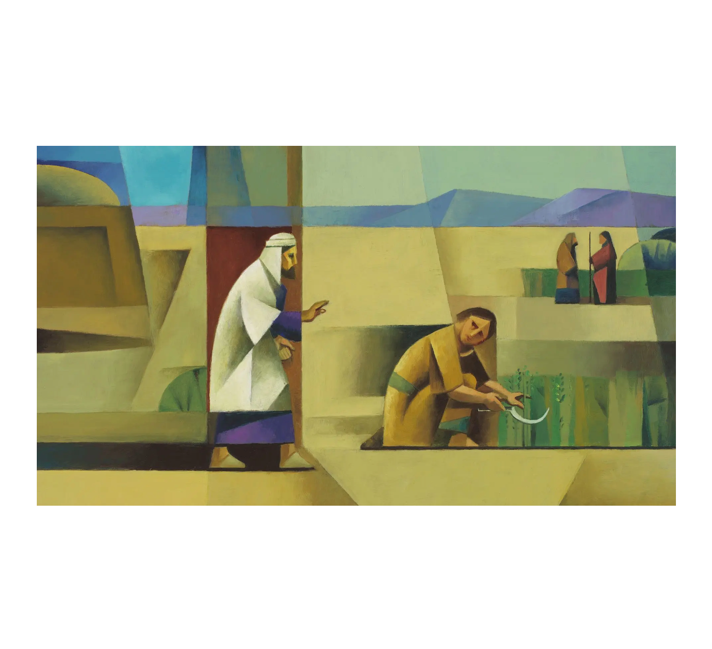
This Sunday’s gospel contains the parable of the wheat and tares and embraces these realities of our lives; lived in God, amongst God’s people; not perfect, but redeemed. The parable suggests helpfully that each life, each community, will be a mixture of good and not so good - wheat and weeds; and that mixed together they must, for the present at least, remain together, as seeking to pull out the weeds disturbs the wheat. The imagery encourages realism, humility and hope.
However, the parable also contains rather more disturbing imagery of a final separation where the tares will be burnt in ‘a furnace of fire where there will be weeping and gnashing of teeth’. The weeds, suggests Jesus, are ‘all causes of sin and all evildoers’. It’s harder to know what to make of this, and good to ponder carefully; though I do hope for the end of ‘all causes of sin’ - the many things that trip us up, disrupting and dividing, distorting and corrupting lives and relationships.
Last Sunday’s gospel was the parable of the sower, and I preached on its themes in the Cathedral at Tatjana’s first celebration of the Eucharist. I’m going to end by quoting myself (!) exploring the ongoing work of interpreting parables, and why any single interpretation is partial and provisional.
“The purpose of parables is to unsettle our knowing, to make uncertain our certainties, to make us ask “is it really like this after all?”
We thought we’d heard and seen and comprehended; but wait…
Following the story of the sower, Jesus launches into the next parable, introducing it like this:-
“The kingdom of heaven may be compared to…”
In other words, the kingdom is like this,
and it’s also NOT like this - and it’s left to us to work it out.”
So, as sheep of Christ’s own flock, and sinners of his own redeeming, lets continue, together, to work it out; and to do so faithfully and generously, recognising that the ‘field’ of each of our lives contains ‘weeds as well as wheat’!
In prayer and friendship,
David
